
In the form of a paint, the "whitest white" in the world reflects so much light that surfaces become cooler than the surrounding air.
- Scientists at Purdue University have developed the whitest white ever created, in the form of a paint.
- This new paint can cool the surfaces it is applied to, which could reduce the need for climate-harming air conditioners.
- It is the second-whitest white ever made by these researchers, who believe it is the whitest a material could ever achieve.
A few years ago, researchers announced the development of the blackest black, a place where colors seem to disappear. This was Vantablack, which absorbed so much visible light that only an infinitesimal amount escaped its surface to be reflected to our eyes. (All the light energy is dissipated into the surrounding substrate, so Vantablack does not become hot).
In a 2021 article published in ACS Applied Materials & Interfaces, scientists at Purdue University presented BaSO4 (barium sulfate), the whitest white to date. BaSO4 is virtually impervious to colors in the visible spectrum. Even better, while it is a very cool invention in the colloquial sense, it is also thermally cool.
The coldest white
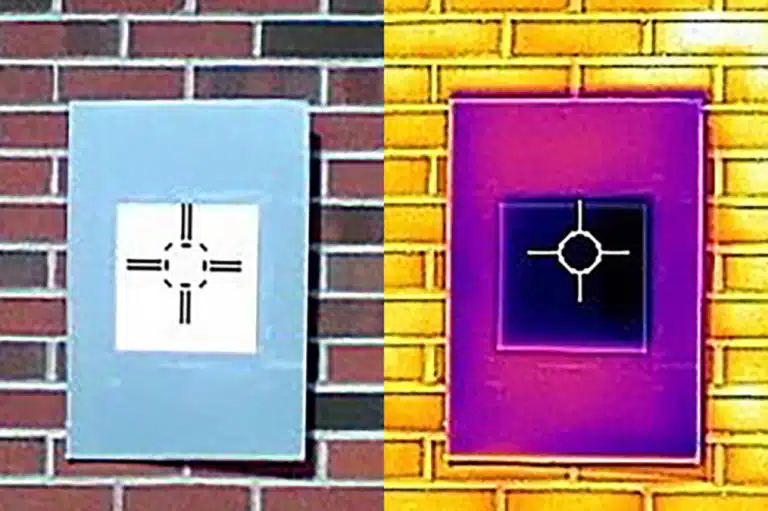
Most exterior paints actually warm the surfaces they are applied to. Although reflective paints are already on the market, they only reflect 80 to 90% of sunlight, which is not enough to achieve a cooling effect.
By contrast, with BaSO4, 98.1% of sunlight is reflected. Xuilin Ruan, lead researcher, said in a press release: "If you used this paint to cover a roof area of about 1,000 square feet (approximately 93 m²), we estimate you could achieve a cooling power of 10 kilowatts. That's more powerful than the central air conditioners used in most homes."
Mr. Ruan and his colleagues tested BaSO4 using thermocouples, high-precision devices that measure voltage to determine temperature. They found that at night, BaSO4 surfaces were 19°F (10.56°C) cooler than the ambient air. Under strong sunlight, the effect is not as extreme, but still dramatic: 8°F (4.4°C) of cooling.
The researchers even found that the paint worked in cold weather. In a test on a day at 43°F (6°C), the surface painted with BaSO4 was at 25°F (-3.8°C). Their tests also indicate that BaSO4 is durable enough for outdoor use.
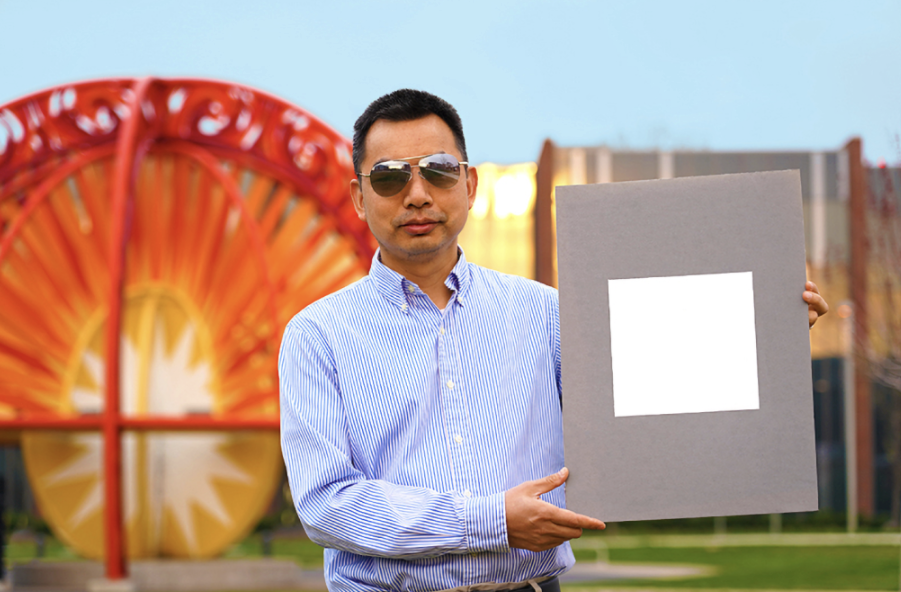
Research into radiative paint for cooling dates back to the 1970s, but Mr. Ruan's team has been working on BaSO4 for only six years. Along the way they analyzed more than 100 reflective materials and tested them in around fifty experimental formulations.
The lead author, postdoctoral researcher Xiangyu Li, explains: "We examined various commercial products, basically everything that is white. We discovered that by using barium sulfate, you can theoretically make products very, very reflective, which means they are very, very white."
The whitest white paint developed by the same team last fall was based on calcium carbonate, a compound commonly found in shells, rocks, and schoolroom chalk.
The team introduced as many tiny BaSO4 particles as possible into the paint. Li explains: "Although a higher particle concentration is preferable to make something white, you cannot increase the concentration too much. The higher the concentration, the more the paint will crack or flake."
Another factor that makes the team's BaSO4 formulation so reflective is that the researchers used barium sulfate particles of different sizes. When it comes to reflecting light, size matters.
Joseph Peoples, co-author and doctoral student, explains: "A high concentration of particles of different sizes gives the paint the widest spectral scattering, which contributes to the highest reflectance."
The formulation method used by the team is compatible with commercial paint production.
Purdue has filed a patent application for the BaSO4, but there are currently no plans to commercialize it.
However, the sooner they bring it to market, the better. Air conditioning currently accounts for 12% of energy consumption in the United States. In addition, many air conditioners use hydrofluorocarbons (HFCs). Although HFCs make up only a small percentage of greenhouse gases, they trap thousands of times more heat than carbon dioxide.
BaSO4 can therefore play a role in the fight against global warming by reducing energy consumption and HFC emissions.
This article by Robby Berman was originally published on Big Think in April 2021. It was updated in August 2022. Translated by artofroof.com in April 2023. Source


